Diffusion Models For Medical Imaging
A MICCAI 2023 tutorial covering diffusion model theory, applications in medical imaging, and hands-on demos with MONAI Generative Models.
← Back to TutorialsA MICCAI 2023 Tutorial.
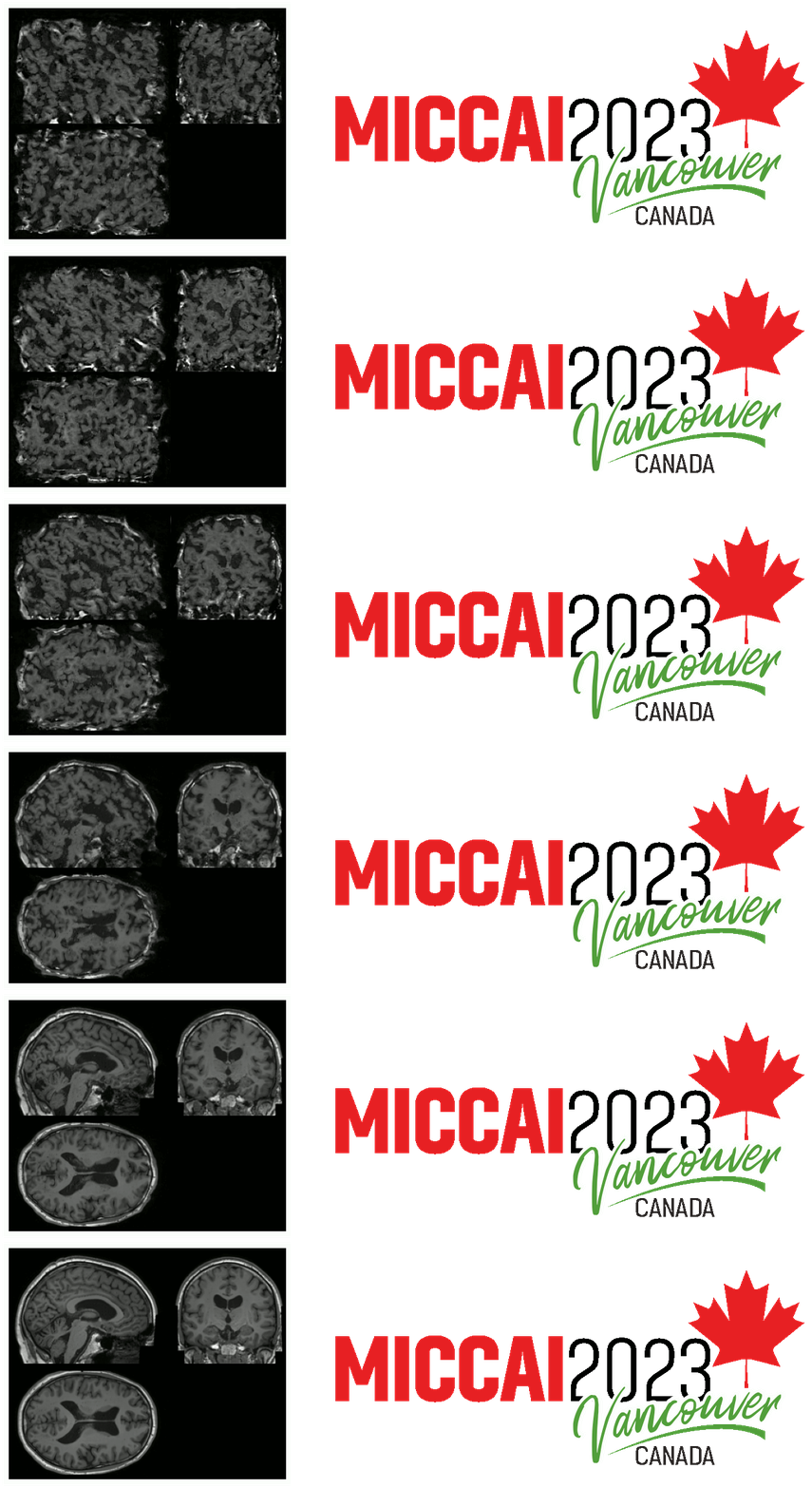 Animation based on [2]
News
- 2023-10-09: Slides available here.
- 2023-10-08: Thank you everyone who contributed to the tutorial! We had a great time and we hope you did too! We will be uploading the slides and the code soon. Stay tuned!
- 2023-10-01: Tutorial location: Vancouver Convention Center East Building Level 1 - Meeting Room 8.
- 2023-07-30: The tutorial will happen on 8 October 2023 - Sunday afternoon (PM).
- 2023-03-14: The tutorial Diffusion Models for Medical Imaging has been ACCEPTED for MICCAI 2023!
Outline
Generative models have advanced rapidly in recent years, enabling the creation of high-quality synthetic data across images, volumes, and other complex data types. Diffusion models, in particular, have become a powerful framework for medical image generation, reconstruction, denoising, segmentation, anomaly detection, and related tasks.
This tutorial presents an overview of generative modelling with a focus on diffusion models, including theory, practical training heuristics, and representative applications in medical imaging. It also includes a hands-on session built on the open-source MONAI generative models library.
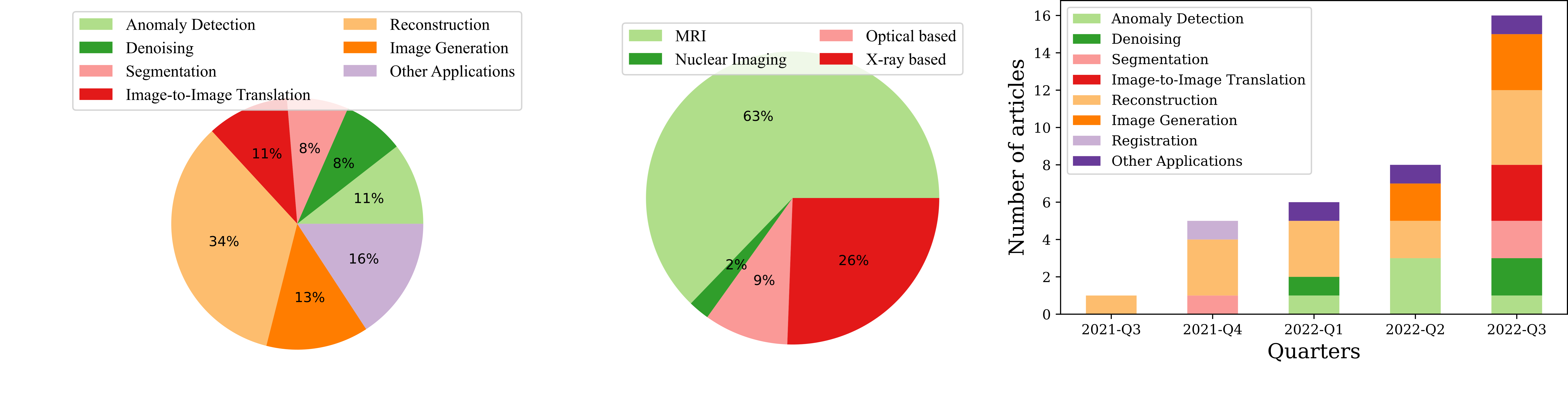 Figure from [1]
Tutorial Schedule
- Introduction [60 mins]
- Introduction to generative models
- Diffusion models theory
- Denoising diffusion probabilistic models
- Training and Inference
- MONAI Generative Models: Introduction and DEMO Coding tutorial on DDPM
- Advanced Topics [60 min]
- Schedulers: How to accelerate sampling? Deterministic Sampling
- Conditioning: Classifier Guidance; Classifier-free Guidance; Super-resolution; Inpainting; Others.
- MONAI Generative Models: DEMO on Classifier-free guidance
-
Coffee break (30mins)
-
Applications in medical imaging [60 mins]
- Synthesis
- Reconstruction
- Segmentation
- Anomaly Detection
- Miscellaneous
- Round table [60 mins]
- Trends and open challenges
- Round table (We invite experts in the field to join the discussion)
- Q&A
Learning Objectives
- Understand the differences between implicit vs explicit likelihood generative models
- Understand the intuition and theory behind diffusion models
- Appreciate and learn different applications of diffusion models in medical image analysis and imaging
- Appreciate current limitations of diffusion models
- Learn how to use MONAI Generative Models to train and use diffusion models
Organizing Team
-
Mr. Pedro Sanchez is a PhD student at the University of Edinburgh
-
Dr. Walter H L Pinaya is a research fellow at the Department of Biomedical Engineering at the King’s College London.
-
Dr. Julia Wolleb is a postdoctoral researcher at the Department of Biomedical Engineering at the University of Basel.
-
Prof Dorit Merhof is Chair in Image Analysis and Computer Vision with the University of Regensburg (UR), Germany.
-
Prof. Jorge Cardoso is a Reader in Artificial Medical Intelligence at King’s College London. Jorge is also the CTO of the new London Medical Imaging and AI Centre for Value-based Healthcare.
-
Prof Sotirios A. Tsaftaris is the Canon Medical / Royal Academy of Engineering Research Chair in Healthcare AI with the University of Edinburgh, United Kingdom.
Some Resources
- Kazerouni, Amirhossein, et al. “Diffusion models for medical image analysis: A comprehensive survey.” arXiv preprint arXiv:2211.07804 (2022).
- Pinaya, Walter HL, et al. “Brain imaging generation with latent diffusion models.” Deep Generative Models: Second MICCAI Workshop, DGM4MICCAI 2022 (2022).
- https://github.com/heejkoo/Awesome-Diffusion-Models is a useful GitHub repository tracking recent diffusion-model papers.